

Traffic Psychology: Understanding the Buyer’s Journey Through Data 🧠📊
Table of Contents
1. Introduction: The Psychology Behind Every Click
2. What is Traffic Psychology?
3. The Modern Buyer’s Journey: A Data-Driven Perspective
4. Key Psychological Triggers That Drive Online Behavior
5. Essential Data Points for Understanding Your Audience
6. Mapping Emotional States to Customer Journey Stages
7. Practical Strategies for Leveraging Traffic Psychology
8. Common Mistakes to Avoid When Analyzing Buyer Behavior
9. Tools and Technologies for Traffic Psychology Analysis
10. Conclusion: Turning Insights into Action
11. Frequently Asked Questions
Introduction: The Psychology Behind Every Click 🔍
Have you ever wondered why some visitors bounce off your website within seconds while others spend hours exploring your content? The answer lies in understanding traffic psychology – the fascinating intersection of human behavior and digital analytics that reveals the true story behind every click, scroll, and conversion.

In today’s hyper-competitive digital landscape, successful businesses don’t just track metrics; they decode the psychological patterns hidden within their data. By understanding the buyer’s journey through a psychological lens, you can transform cold statistics into warm insights that drive meaningful connections with your audience.
This comprehensive guide will take you on a journey through the minds of your website visitors, showing you how to interpret behavioral data as psychological signals and use these insights to create more compelling, conversion-focused experiences. 🚀
What is Traffic Psychology? 🎯
Traffic psychology is the study of how psychological principles influence online user behavior and decision-making processes. It combines traditional psychology concepts with digital analytics to understand why people behave the way they do on websites and digital platforms.
Think of it as being a detective in the digital world. Every page view, time spent on site, and interaction pattern tells a story about your visitor’s mental state, motivations, and decision-making process. When we analyze traffic data through a psychological framework, we uncover the “why” behind the “what.”
For instance, a high bounce rate on your pricing page might not just indicate poor design – it could reveal psychological barriers like price anchoring effects or decision paralysis. Understanding these nuances allows you to address the root psychological causes rather than just treating symptoms.
The Modern Buyer’s Journey: A Data-Driven Perspective 📈
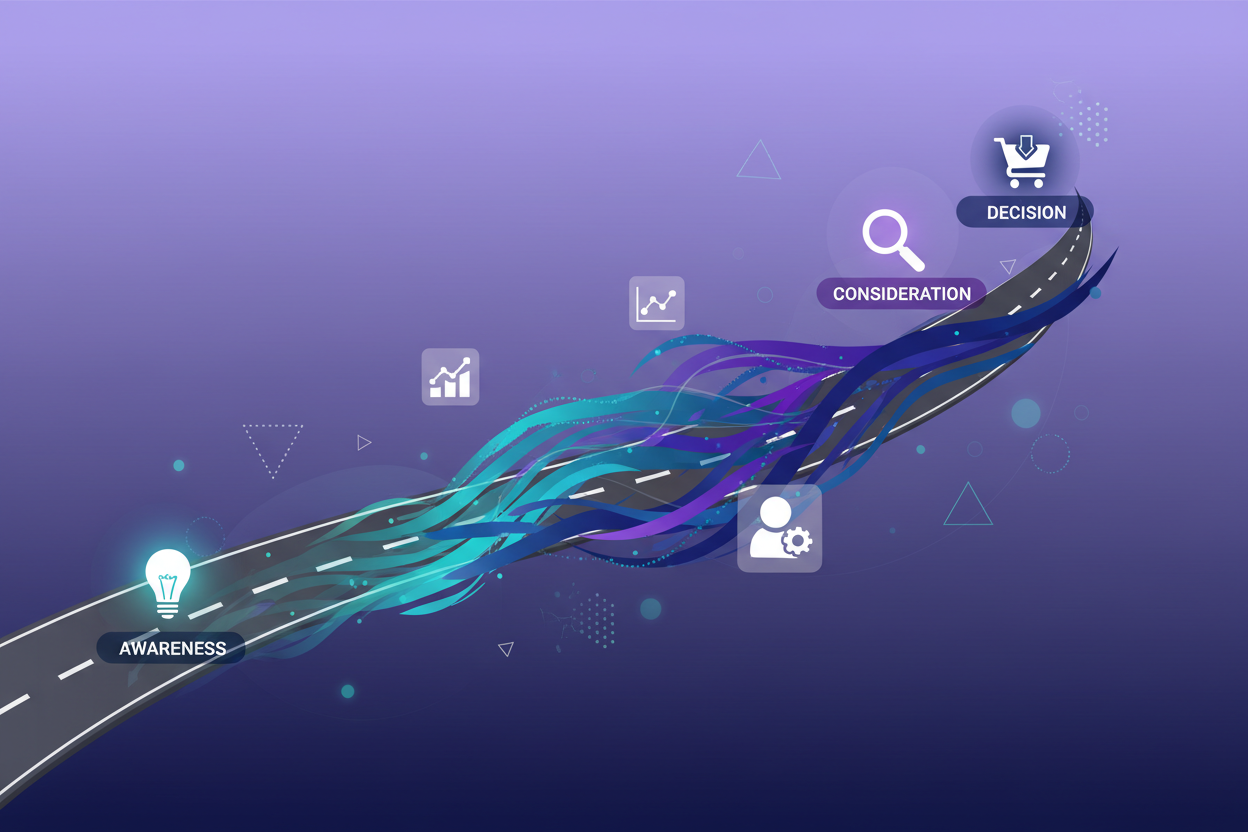
The traditional linear buyer’s journey (awareness → consideration → decision) has evolved into a complex, multi-touchpoint experience that reflects how our brains actually process information and make decisions.
Modern buyers don’t follow a straight path. Instead, they zigzag through various stages, sometimes moving backward, sometimes jumping ahead, and often experiencing multiple micro-moments of truth along the way. Data reveals this reality through patterns like:
Multiple Session Patterns: The average B2B buyer visits a website 7-12 times before making a purchase decision. Each visit represents a different psychological state and information need.
Cross-Device Behavior: Users research on mobile during commutes, compare options on tablets at home, and often complete purchases on desktop. This fragmented journey reflects different psychological contexts and decision-making modes.
Social Proof Seeking: Data shows that 92% of consumers read reviews before making a purchase, indicating the psychological need for validation and risk reduction.
Key Psychological Triggers That Drive Online Behavior 🧩
Understanding the psychological triggers that influence online behavior is crucial for interpreting your traffic data correctly. Here are the most impactful ones:
Loss Aversion: People feel the pain of losing something twice as strongly as the pleasure of gaining something equivalent. This explains why limited-time offers and scarcity messaging can dramatically impact conversion rates.
Social Proof: We look to others’ behavior to guide our own decisions, especially in uncertain situations. Traffic data often shows increased conversions on pages with testimonials, reviews, and user-generated content.
Cognitive Load Theory: Our brains can only process a limited amount of information at once. Pages with high bounce rates might be overwhelming visitors with too many choices or complex layouts.
Anchoring Bias: The first piece of information we encounter heavily influences subsequent decisions. This is why the order of pricing plans or product features can significantly impact user behavior patterns.
The Paradox of Choice: Too many options can lead to decision paralysis. Analytics often reveal that pages with fewer, well-curated options perform better than those with extensive catalogs.
Essential Data Points for Understanding Your Audience 📊
To truly understand traffic psychology, you need to look beyond surface-level metrics and dive into behavioral indicators that reveal psychological states:
Micro-Interactions: Scroll depth, hover patterns, and click heatmaps reveal attention and interest levels. Deep scrolling might indicate high engagement, while erratic clicking patterns could suggest confusion or frustration.
Session Duration vs. Page Depth: Short sessions with many page views might indicate browsing behavior, while long sessions on few pages suggest deep consideration or potential obstacles.
Return Visitor Patterns: The frequency and timing of return visits can indicate where users are in their decision-making process. Multiple visits to pricing pages followed by competitor research suggests active comparison shopping.
Exit Page Analysis: Understanding where users leave your site reveals potential psychological barriers or moments when they’ve gathered enough information to make a decision elsewhere.
Form Abandonment Patterns: Where users drop off in forms can indicate psychological friction points – too much commitment too early, privacy concerns, or perceived effort vs. value mismatches.
Mapping Emotional States to Customer Journey Stages 💭
Each stage of the buyer’s journey corresponds to different emotional and psychological states that manifest in measurable behaviors:
Awareness Stage – Curiosity and Information Seeking: Users in this stage typically have longer session durations, visit multiple blog posts or educational content, and show high engagement with how-to guides and industry insights. Their behavior reflects an open, exploratory mindset.
Consideration Stage – Comparison and Evaluation: This stage is characterized by visits to product pages, pricing information, and competitor comparisons. Users often bookmark pages, download resources, and show patterns of returning to compare options. The psychological state here involves careful analysis and risk assessment.
Decision Stage – Commitment and Validation Seeking: Users focus on testimonials, case studies, and detailed product specifications. They often spend significant time on checkout pages and may abandon carts while seeking additional validation. The dominant emotions are excitement mixed with purchase anxiety.
Post-Purchase – Satisfaction and Advocacy: Behavior shifts to support content, community engagement, and sharing activities. Users seek validation that they made the right choice and look for ways to maximize their investment.
Practical Strategies for Leveraging Traffic Psychology 🛠️
Now that we understand the psychological foundations, let’s explore how to apply these insights practically:
Create Psychological Funnels: Instead of traditional conversion funnels, design pathways that address psychological needs at each stage. For anxious buyers, provide more social proof. For analytical types, offer detailed comparisons and data.
Implement Progressive Disclosure: Reduce cognitive load by revealing information gradually. Start with high-level benefits and allow users to drill down into details as their interest and commitment levels increase.
Use Behavioral Triggers: Implement elements like exit-intent popups, time-based offers, and personalized recommendations based on browsing patterns to address specific psychological states in real-time.
Optimize for Emotional Journey: Design your site architecture to support the emotional ups and downs of the buyer’s journey. Provide reassurance during high-anxiety moments and excitement during decision points.
A/B Test Psychological Elements: Test different psychological approaches – urgency vs. scarcity, social proof vs. expert authority, or detailed information vs. simplified messaging – to understand what resonates with your specific audience.
Common Mistakes to Avoid When Analyzing Buyer Behavior ⚠️
Even with the best intentions, it’s easy to misinterpret psychological signals in your data. Here are common pitfalls to avoid:
Assuming Correlation Equals Causation: Just because users who view your testimonial page convert more doesn’t mean testimonials cause conversions. They might indicate users who are already further along in their decision process.
Ignoring Context: The same behavior can mean different things in different contexts. A quick visit might indicate efficiency and satisfaction, or it could suggest the user didn’t find what they needed.
Over-Optimizing for Metrics: Focusing solely on improving metrics like time on page or page views without considering the psychological experience can lead to manipulative design that ultimately hurts conversions.
Neglecting Emotional Cycles: User psychology changes based on time of day, day of week, and seasonal factors. Failing to account for these cycles can lead to misguided optimization efforts.
One-Size-Fits-All Thinking: Different user segments have different psychological profiles. What works for enterprise buyers might not work for small business owners, even if they’re buying the same product.
Tools and Technologies for Traffic Psychology Analysis 🔧
The right tools can help you uncover psychological insights that traditional analytics might miss:
Heatmap and Session Recording Tools: Platforms like Hotjar, Crazy Egg, and FullStory show you exactly how users interact with your pages, revealing psychological states through behavior patterns.
Advanced Analytics Platforms: Google Analytics 4, Adobe Analytics, and Mixpanel offer behavioral cohort analysis and user journey mapping that can reveal psychological patterns over time.
User Feedback Tools: Surveys, polls, and feedback widgets provide direct insight into user psychology and can validate or challenge your behavioral data interpretations.
A/B Testing Platforms: Tools like Optimizely, VWO, and Google Optimize allow you to test psychological hypotheses and measure their impact on user behavior and conversions.
Customer Journey Analytics: Specialized tools like Amplitude, Heap, and Klaviyo help you understand the complete psychological journey across all touchpoints and channels.
Conclusion: Turning Insights into Action 🎯
Understanding traffic psychology isn’t just about collecting more data – it’s about developing empathy for your users and creating experiences that truly serve their psychological needs throughout their journey.
The most successful businesses of the future will be those that can seamlessly blend human psychology with data science, creating digital experiences that feel intuitive, supportive, and genuinely helpful. By viewing your traffic data through a psychological lens, you’re not just optimizing for conversions – you’re building relationships based on understanding and trust.
Remember, behind every data point is a real person with real emotions, concerns, and motivations. When you honor that humanity in your analysis and optimization efforts, you create experiences that not only convert better but also build lasting customer relationships.
Start small by choosing one aspect of your current analytics to view through a psychological framework. Ask yourself: “What might this behavior tell me about how my users are feeling?” The insights you uncover might surprise you and could be the key to unlocking your next level of growth. 🚀
Frequently Asked Questions ❓
Q: How long does it take to see results from traffic psychology optimization?
A: You can often see initial behavioral changes within 2-4 weeks of implementing psychology-based optimizations. However, meaningful conversion improvements typically require 6-12 weeks of testing and refinement to account for user learning curves and seasonal variations.
Q: Can traffic psychology principles work for all types of businesses?
A: Yes, but the specific psychological triggers and their applications vary significantly by industry, target audience, and business model. B2B services might focus more on authority and trust signals, while e-commerce sites might emphasize urgency and social proof.
Q: What’s the biggest mistake companies make when applying traffic psychology?
A: The most common mistake is applying psychological principles without understanding your specific audience. What works for one demographic or industry might backfire with another. Always test psychological assumptions with your actual users.
Q: How do I know if my traffic psychology analysis is accurate?
A: Validate your psychological interpretations by combining multiple data sources – quantitative analytics, qualitative user feedback, and direct user testing. Look for consistent patterns across different data types before making major optimization decisions.
Q: Is traffic psychology manipulation?
A: When done ethically, traffic psychology is about understanding and serving user needs better, not manipulating them. The goal should always be to help users make decisions that genuinely benefit them, while also achieving your business objectives.


