

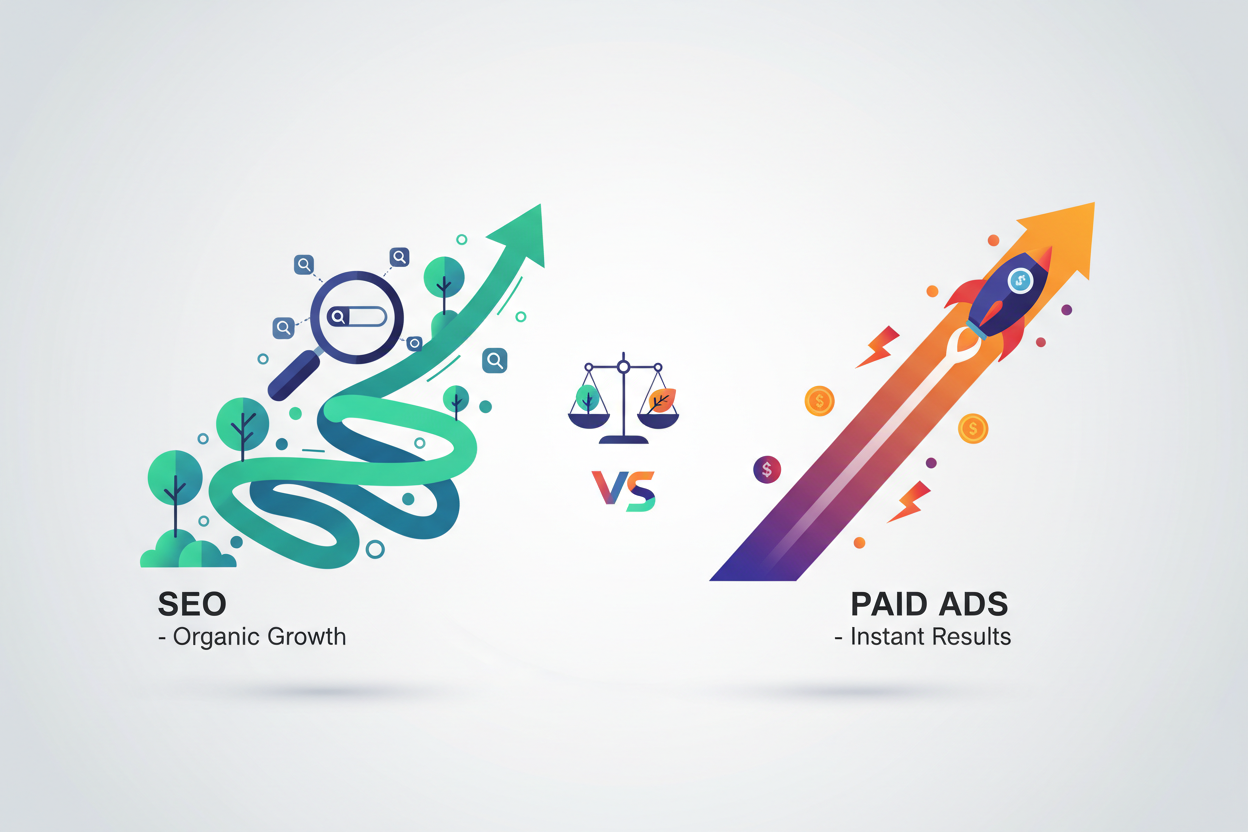
SEO vs. Paid Ads: The Ultimate Traffic Showdown 🥊
Table of Contents
1. Introduction: The Battle for Digital Visibility
2. Understanding SEO: The Marathon Runner
3. Decoding Paid Advertising: The Sprinter
4. Cost Comparison: Where Your Budget Goes
5. Timeline Expectations: When Results Actually Show Up
6. Traffic Quality: Not All Visitors Are Created Equal
7. Long-term Sustainability: Building vs. Renting Traffic
8. Control and Flexibility: Who’s Really in Charge?
9. The Hybrid Approach: Why Not Both?
10. Making the Right Choice for Your Business
11. Conclusion: The Winner Takes It All (Or Do They?)
12. Frequently Asked Questions
Introduction: The Battle for Digital Visibility 🎯
Picture this: You’re standing at a crossroads in the digital marketing world, wallet in one hand, SEO strategy in the other. Sound familiar? If you’ve ever found yourself torn between investing in search engine optimization or throwing money at paid advertisements, you’re definitely not alone in this struggle.

The truth is, both SEO and paid ads can drive serious traffic to your website, but they work in completely different ways. It’s like comparing a marathon runner to a sprinter – both are athletes, both can win races, but their strategies couldn’t be more different.
In today’s competitive online landscape, understanding the nuances between organic search optimization and paid advertising isn’t just helpful – it’s absolutely crucial for your business success. Whether you’re a startup founder counting every penny or an established business looking to maximize ROI, this comprehensive comparison will help you make the right choice for your unique situation.
Understanding SEO: The Marathon Runner 🏃♂️
Search Engine Optimization is like that friend who takes forever to get ready but always looks absolutely stunning when they finally show up. SEO involves optimizing your website, content, and online presence to rank higher in organic search results.
When someone searches for “best coffee shops near me” and your café appears in the top three results without any “Ad” label, that’s SEO working its magic. You didn’t pay Google directly for that placement – you earned it through consistent effort, quality content, and technical optimization.
The SEO process involves keyword research, on-page optimization, technical improvements, link building, and creating valuable content that answers your audience’s questions. It’s a comprehensive approach that touches every aspect of your online presence.
What makes SEO particularly appealing is its compound effect. Every blog post you write, every page you optimize, and every quality backlink you earn contributes to your overall domain authority. It’s like building a snowball that gets bigger and more powerful as it rolls downhill.
Decoding Paid Advertising: The Sprinter ⚡
Paid advertising, on the other hand, is the Usain Bolt of digital marketing – fast, powerful, and delivers immediate results. Whether we’re talking about Google Ads, Facebook advertising, or any other pay-per-click platform, paid ads can put your business in front of potential customers within hours.
With paid advertising, you’re essentially renting space in the digital world. You bid on keywords, create compelling ad copy, and pay each time someone clicks on your advertisement. The moment you stop paying, your visibility disappears – but while you’re paying, you have incredible control over who sees your ads and when.
Modern paid advertising platforms offer sophisticated targeting options that would make a detective jealous. You can target people based on their demographics, interests, online behavior, and even their recent purchase history. Want to show ads only to 25-35 year old coffee lovers in Seattle who visited your website last week? No problem!
Cost Comparison: Where Your Budget Goes 💰
Let’s talk money – because let’s be honest, that’s probably what’s keeping you up at night. The cost structures of SEO and paid ads are as different as night and day.
SEO requires an upfront investment in time, tools, and often professional services, but it doesn’t have ongoing “per-click” costs. You might spend $2,000-$10,000 monthly on SEO services (depending on your business size), but once you start ranking, additional organic traffic doesn’t cost extra. It’s like buying a house – big upfront cost, but then you own the asset.
Paid advertising works more like renting an apartment. Google Ads costs can range from $1 to $50+ per click depending on your industry and competition. If you’re in a competitive field like insurance or legal services, you might pay $100+ for a single click! The average small business spends $9,000-$10,000 monthly on Google Ads.
Here’s where it gets interesting: while SEO seems more expensive initially, the cost per acquisition often decreases over time as your rankings improve. With paid ads, your costs remain relatively constant – you pay the same amount for click #1 as you do for click #10,000.
Timeline Expectations: When Results Actually Show Up ⏰
Patience is a virtue, especially in SEO. If someone promises you first-page rankings in 30 days, run the other direction – they’re probably selling snake oil or using black-hat techniques that’ll get you penalized.
Realistic SEO timelines look something like this: You might see some movement in 3-4 months, meaningful results in 6-8 months, and substantial organic traffic growth in 12-18 months. It’s not uncommon for competitive keywords to take 2+ years to rank on the first page.
Paid advertising is the complete opposite. You can literally create an ad campaign during your lunch break and start seeing traffic within hours. I’ve personally launched campaigns that generated leads the same day – it’s that fast.
However, here’s the catch with paid ads: while you get immediate traffic, optimizing for profitability takes time. You’ll need weeks or months of data to understand which keywords convert best, what ad copy resonates with your audience, and how to optimize your campaigns for maximum ROI.
Traffic Quality: Not All Visitors Are Created Equal 🎯
This is where things get really interesting, and honestly, it’s one of my favorite topics to discuss with clients. The quality of traffic from SEO versus paid ads can vary significantly, and understanding this difference is crucial.
Organic traffic typically has higher intent and trust levels. When someone clicks on an organic result, they’re essentially saying, “Google thinks this website is the best answer to my question, so I trust it too.” These visitors often spend more time on your site, have lower bounce rates, and convert at higher rates.
Studies consistently show that organic traffic converts 2-3 times better than paid traffic. There’s something psychological about earning your way to the top versus paying for it that resonates with users.
Paid traffic, however, gives you incredible targeting precision. You can reach people at specific stages of the buying journey, retarget website visitors, and even target your competitors’ customers. While the overall conversion rate might be lower, the volume and targeting capabilities often make up for it.
Long-term Sustainability: Building vs. Renting Traffic 🏗️
Think of SEO as building your own house, while paid advertising is like staying in a hotel. Both provide shelter, but the long-term implications are vastly different.
With SEO, every piece of content you create, every optimization you make, and every quality backlink you earn becomes part of your digital asset portfolio. Even if you stop actively working on SEO for a few months, your rankings don’t immediately disappear. You’ve built something that has lasting value.
I’ve seen websites maintain strong organic traffic for years with minimal ongoing SEO work, simply because they built a solid foundation. It’s like compound interest – the benefits accumulate over time.
Paid advertising, conversely, is immediate but temporary. The second you pause your campaigns, your traffic stops. There’s no residual benefit from last month’s ad spend. It’s pure pay-to-play, which can be both liberating (immediate control) and terrifying (constant expense).
Control and Flexibility: Who’s Really in Charge? 🎮
Control freaks, this section is for you! The level of control you have over your traffic differs dramatically between these two approaches.
With paid advertising, you’re the puppet master. Want to increase traffic by 50% tomorrow? Just increase your budget. Need to pause all marketing due to inventory issues? Turn off your campaigns instantly. Want to test a new message? Create an ad variation and have results within hours.
SEO is more like steering a cruise ship – powerful, but changes take time to implement and see results. Google’s algorithm updates can impact your rankings overnight, and you have limited control over when and how your organic traffic fluctuates.
However, SEO gives you something paid ads can’t: independence from advertising platforms. You’re not at the mercy of Facebook’s policy changes or Google’s increasing ad costs. Your organic presence is yours to control.
The Hybrid Approach: Why Not Both? 🤝
Here’s where I get a bit rebellious – who says you have to choose just one? The most successful businesses I work with use both SEO and paid advertising strategically, and the combination is often more powerful than the sum of its parts.
Smart marketers use paid ads to test keywords and messaging quickly, then apply those insights to their SEO strategy. They use SEO data to identify high-converting organic keywords, then bid on those terms in paid campaigns for maximum visibility.
A hybrid approach might look like this: Use paid ads for immediate traffic and revenue while building your SEO foundation. As your organic rankings improve, gradually shift budget from paid ads to content creation and link building. Keep some paid advertising for competitive keywords and new product launches.
This strategy provides both immediate results and long-term growth, reducing risk while maximizing opportunities. It’s like having both a savings account and investment portfolio – different purposes, but both important for financial health.
Making the Right Choice for Your Business 🤔
So, which should you choose? Well, it depends on several factors that are unique to your business situation.
Choose SEO if you have limited ongoing budget but can invest upfront, you’re in a less competitive niche, you have time to wait for results, or you want to build long-term brand authority. SEO is also ideal if you have great content creation capabilities and can commit to consistent optimization efforts.
Choose paid advertising if you need immediate results, have budget for ongoing ad spend, operate in a highly competitive market, or want precise control over your traffic. Paid ads are also perfect for seasonal businesses, product launches, or when you need to test market demand quickly.
Consider your business model too. E-commerce sites often benefit more from paid ads due to their transactional nature, while service-based businesses might see better ROI from SEO’s trust-building benefits.
Conclusion: The Winner Takes It All (Or Do They?) 🏆
After diving deep into this SEO versus paid advertising showdown, here’s the truth bomb: there isn’t a universal winner. Both strategies have their place in a well-rounded digital marketing portfolio, and the “best” choice depends entirely on your business goals, budget, timeline, and market situation.
SEO is your long-term wealth-building strategy – it takes patience and consistent effort, but the compound returns can be incredible. Paid advertising is your immediate income generator – it costs more ongoing but delivers results you can bank on today.
The most successful businesses don’t see this as an either-or decision. They view SEO and paid ads as complementary strategies that work better together than apart. Start with your most pressing needs and budget constraints, but always keep the bigger picture in mind.
Remember, digital marketing isn’t about finding the “perfect” strategy – it’s about finding the right strategy for your business at this moment, then adapting as you grow and learn. Whether you choose SEO, paid ads, or both, the key is to start, measure, learn, and optimize continuously.
Frequently Asked Questions 🙋♀️
Q: How long does it take to see results from SEO?
A: Most businesses see initial improvements in 3-4 months, with significant results typically appearing in 6-12 months. Competitive keywords may take 18+ months to rank on the first page.
Q: Is SEO really “free” traffic?
A: While you don’t pay per click like with ads, SEO requires investment in time, tools, content creation, and often professional services. It’s more accurate to call it “earned” rather than “free” traffic.
Q: Can I pause my SEO efforts like I can with paid ads?
A: SEO isn’t something you can easily pause and restart. While rankings don’t disappear overnight, stopping SEO work allows competitors to catch up and can lead to gradual ranking declines.
Q: Which converts better – organic or paid traffic?
A: Organic traffic typically converts 2-3 times better than paid traffic due to higher trust levels and user intent. However, paid traffic offers better targeting and volume control.
Q: Should small businesses focus on SEO or paid ads?
A: It depends on your immediate needs and budget. If you need quick results and have ad budget, start with paid ads. If you can invest time for long-term growth, prioritize SEO. Ideally, use both strategically.
Q: How much should I budget for SEO vs. paid ads?
A: SEO typically requires $2,000-$10,000+ monthly depending on competition and business size. Paid ads can range from $1,000-$50,000+ monthly. Start with what you can afford and scale based on results.


