

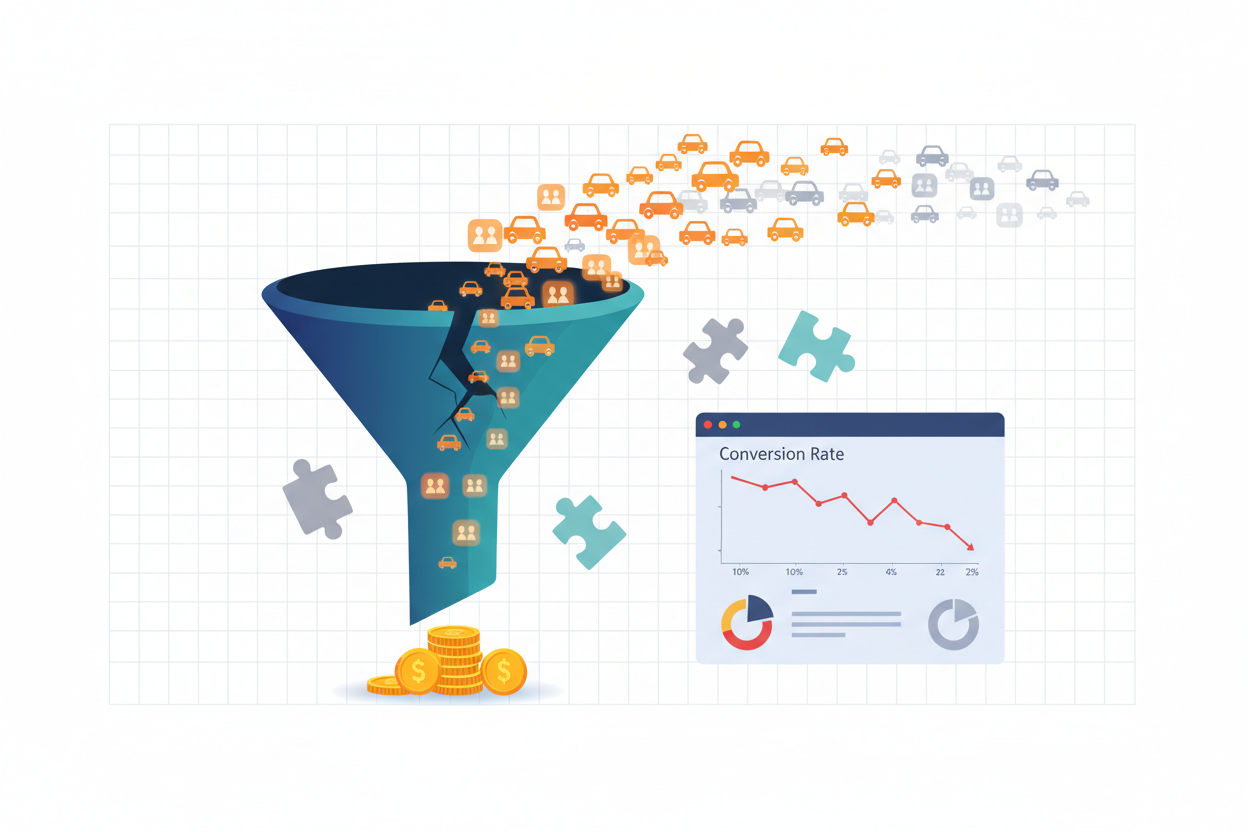
Why Your Traffic Isn’t Converting and How to Fix It: The Ultimate Guide to Boosting Your Conversion Rate 📈
Table of Contents
• Understanding Traffic vs. Conversions
• The Most Common Conversion Killers
• Website Speed and User Experience Issues
• Targeting the Wrong Audience
• Poor Call-to-Action Strategy
• Trust and Credibility Problems
• Mobile Optimization Failures
• Proven Strategies to Fix Your Conversion Rate
• Measuring and Tracking Your Success
• Frequently Asked Questions
Introduction
You’ve done everything right, haven’t you? Your website traffic is climbing steadily, your SEO efforts are paying off, and visitors are flooding to your site. But here’s the frustrating reality: those visitors aren’t buying, signing up, or taking any meaningful action. Sound familiar? 😤
If you’re nodding your head right now, you’re not alone. This scenario plays out across millions of websites every single day. The harsh truth is that driving traffic is only half the battle – converting that traffic into customers, subscribers, or leads is where the real magic happens.

In this comprehensive guide, we’ll dive deep into the most common reasons why your traffic isn’t converting and, more importantly, provide you with actionable solutions to turn those visitors into valuable customers. Let’s transform your website from a digital ghost town into a conversion powerhouse! 🚀
Understanding Traffic vs. Conversions: The Critical Difference
Before we jump into the problems and solutions, let’s establish what we’re really talking about here. Traffic refers to the number of people visiting your website – it’s a vanity metric that looks impressive in reports but doesn’t necessarily translate to business success.
Conversions, on the other hand, represent the percentage of visitors who complete a desired action on your website. This could be making a purchase, filling out a contact form, subscribing to your newsletter, or downloading a resource. A conversion rate of 2-3% is considered average across most industries, but top-performing websites often achieve rates of 5% or higher.
The relationship between traffic and conversions isn’t always straightforward. You might have thousands of visitors but terrible conversion rates, or modest traffic with exceptional conversion performance. The key is finding the right balance and optimizing for quality over quantity.
The Most Common Conversion Killers 🔪
Let’s be honest – there are dozens of factors that can sabotage your conversion rates. However, after analyzing countless websites and working with businesses across various industries, I’ve identified the most frequent culprits that are likely destroying your conversion potential.
These conversion killers often work in combination, creating a perfect storm of user frustration and abandoned shopping carts. The good news? Once you identify and address these issues, you’ll likely see immediate improvements in your conversion rates.
Website Speed and User Experience Issues
Here’s a sobering statistic: if your website takes longer than 3 seconds to load, you’ll lose approximately 40% of your visitors before they even see your content. In our instant-gratification world, speed isn’t just important – it’s absolutely critical for conversions.
But speed is just one piece of the user experience puzzle. Navigation confusion, broken links, intrusive pop-ups, and cluttered layouts all contribute to a poor user experience that drives potential customers away faster than you can say “bounce rate.”
Consider this: when someone visits your website, they’re essentially asking, “Can you solve my problem quickly and easily?” If your site is slow, confusing, or frustrating to navigate, you’re answering that question with a resounding “No.”
The fix starts with conducting a thorough website audit. Use tools like Google PageSpeed Insights to identify speed issues, and consider implementing a content delivery network (CDN) to improve loading times globally. Simplify your navigation menu, ensure your search function actually works, and remove any unnecessary elements that don’t serve your conversion goals.
Targeting the Wrong Audience 🎯
This might sting a little, but sometimes the problem isn’t your website – it’s who you’re attracting to it. If you’re driving traffic from the wrong sources or targeting keywords that don’t align with buyer intent, you’ll end up with visitors who were never going to convert in the first place.
Think about it this way: if you’re selling premium business software but your traffic comes primarily from people searching for “free alternatives,” you’re facing an uphill battle. These visitors aren’t in a buying mindset, and no amount of optimization will convince someone who’s specifically looking for free solutions to purchase your paid product.
The solution involves refining your traffic acquisition strategy. Analyze your current traffic sources and identify which channels bring visitors with the highest conversion rates. Focus your efforts on these high-performing channels while gradually reducing investment in sources that bring low-quality traffic.
Additionally, review your keyword strategy. Are you targeting informational keywords when you should be focusing on commercial intent keywords? Someone searching for “how to create a budget” is in a different mindset than someone searching for “best budgeting software.” Both searches are valuable, but they require different approaches and expectations.
Poor Call-to-Action Strategy
Your call-to-action (CTA) buttons are the bridge between visitor interest and actual conversion. Yet, I’m constantly amazed by how many websites treat their CTAs as an afterthought. Generic phrases like “Submit” or “Click Here” do nothing to motivate action or communicate value.
Effective CTAs are specific, action-oriented, and benefit-focused. Instead of “Learn More,” try “Get Your Free Marketing Audit.” Rather than “Sign Up,” consider “Start Your 30-Day Free Trial.” The difference might seem subtle, but these small changes can dramatically impact your conversion rates.
Placement matters just as much as copy. Your primary CTA should be visible above the fold, but don’t stop there. Strategic CTA placement throughout your content can capture visitors at different stages of their decision-making process. Someone might not be ready to buy after reading your headline, but they might be convinced after reading your product benefits or customer testimonials.
Trust and Credibility Problems 🛡️
In an era of online scams and data breaches, trust isn’t just nice to have – it’s absolutely essential for conversions. Visitors need to feel confident that you’re legitimate, that their personal information is secure, and that you’ll deliver on your promises.
Trust signals come in many forms: customer testimonials, security badges, professional design, clear contact information, and transparent policies. If your website looks like it was built in 2005, has no customer reviews, or lacks basic security certificates, visitors will hesitate to share their information or make purchases.
Building trust starts with the basics. Ensure your website has an SSL certificate (that little lock icon in the browser). Display customer testimonials prominently, especially on key conversion pages. Include clear contact information and consider adding team photos to humanize your brand. If you have industry certifications or partnerships, showcase them prominently.
Social proof is particularly powerful for building trust. Case studies, customer logos, review ratings, and user-generated content all demonstrate that real people trust your business enough to work with you or buy from you.
Mobile Optimization Failures 📱
With mobile traffic accounting for over 50% of web traffic globally, mobile optimization isn’t optional anymore – it’s mandatory. Yet, countless websites still provide subpar mobile experiences that frustrate users and kill conversions.
Mobile optimization goes beyond just having a responsive design. Your mobile site needs to load quickly, display properly on various screen sizes, and provide an intuitive touch-friendly interface. Forms should be easy to fill out on small screens, buttons should be large enough to tap accurately, and the checkout process should be streamlined for mobile users.
Consider the mobile user’s context as well. Mobile visitors are often multitasking, have limited attention spans, and may be dealing with slower internet connections. Your mobile experience should be even more focused and streamlined than your desktop version.
Proven Strategies to Fix Your Conversion Rate 🔧
Now that we’ve identified the problems, let’s focus on solutions. These strategies have been tested across thousands of websites and consistently deliver measurable improvements in conversion rates.
Start with conversion rate optimization (CRO) fundamentals. Create clear value propositions that immediately communicate what you offer and why visitors should care. Simplify your conversion process by removing unnecessary form fields and steps. If you currently ask for 10 pieces of information, try reducing it to 3-5 essential fields.
Implement A/B testing to make data-driven improvements. Test different headlines, CTA buttons, page layouts, and form designs. Even small changes can yield significant results. For example, changing a button color from blue to orange might seem trivial, but it could increase conversions by 15% or more.
Use urgency and scarcity tactics ethically. Limited-time offers, countdown timers, and stock indicators can motivate action, but use them genuinely. False scarcity will damage your credibility if discovered.
Personalize the user experience based on traffic source, geographic location, or browsing behavior. A visitor from a Google Ad for “enterprise software” should see different messaging than someone who found you through a blog post about small business tips.
Measuring and Tracking Your Success 📊
You can’t improve what you don’t measure. Implementing proper tracking and analytics is crucial for understanding your conversion performance and identifying opportunities for improvement.
Set up conversion tracking in Google Analytics to monitor your key performance indicators (KPIs). Track not just overall conversion rates, but segment them by traffic source, device type, geographic location, and user behavior. This granular data will help you identify which elements are working and which need improvement.
Use heat mapping tools like Hotjar or Crazy Egg to understand how visitors interact with your pages. These tools show you where people click, how far they scroll, and where they abandon your site. This visual data often reveals issues that traditional analytics miss.
Monitor your conversion funnel to identify drop-off points. If 1000 people visit your product page but only 100 add items to their cart, and only 20 complete the purchase, you have clear areas for optimization at each stage.
Conclusion
Converting website traffic into customers isn’t magic – it’s a systematic process of identifying problems, implementing solutions, and continuously optimizing based on data. The strategies we’ve covered in this guide address the most common conversion killers that plague websites across all industries.
Remember, improving conversion rates is an ongoing process, not a one-time fix. Start with the biggest issues first – typically website speed and user experience problems – then work your way through targeting, trust signals, and optimization tactics.
The beautiful thing about conversion rate optimization is that small improvements compound over time. A 1% increase in conversion rate might not seem significant, but over a year, it could represent thousands of additional customers and substantial revenue growth.
Don’t try to implement everything at once. Choose 2-3 strategies from this guide, implement them thoroughly, measure the results, and then move on to the next improvements. Your future self (and your bank account) will thank you for the effort! 💪
Frequently Asked Questions
Q: What’s considered a good conversion rate?
A: Conversion rates vary significantly by industry, but generally, 2-3% is average, 4-5% is good, and anything above 5% is excellent. However, focus on improving your own baseline rather than comparing to industry averages.
Q: How long should I run A/B tests before making decisions?
A: Run tests for at least 1-2 weeks to account for daily variations, and ensure you have at least 100 conversions per variation for statistical significance. Don’t end tests early just because you see positive results.
Q: Should I focus on increasing traffic or improving conversions first?
A: Generally, focus on conversions first. It’s more cost-effective to convert existing traffic better than to drive more traffic to a poorly converting website. Once your conversion rate is optimized, then scale your traffic acquisition efforts.
Q: How often should I update my website for better conversions?
A: Continuously monitor and test, but avoid making too many changes at once. Implement one significant change per month and measure its impact before adding more modifications.
Q: What’s the biggest mistake businesses make with conversion optimization?
A: Making assumptions instead of testing. What works for one website might not work for another. Always test changes with your specific audience rather than copying what others do.


